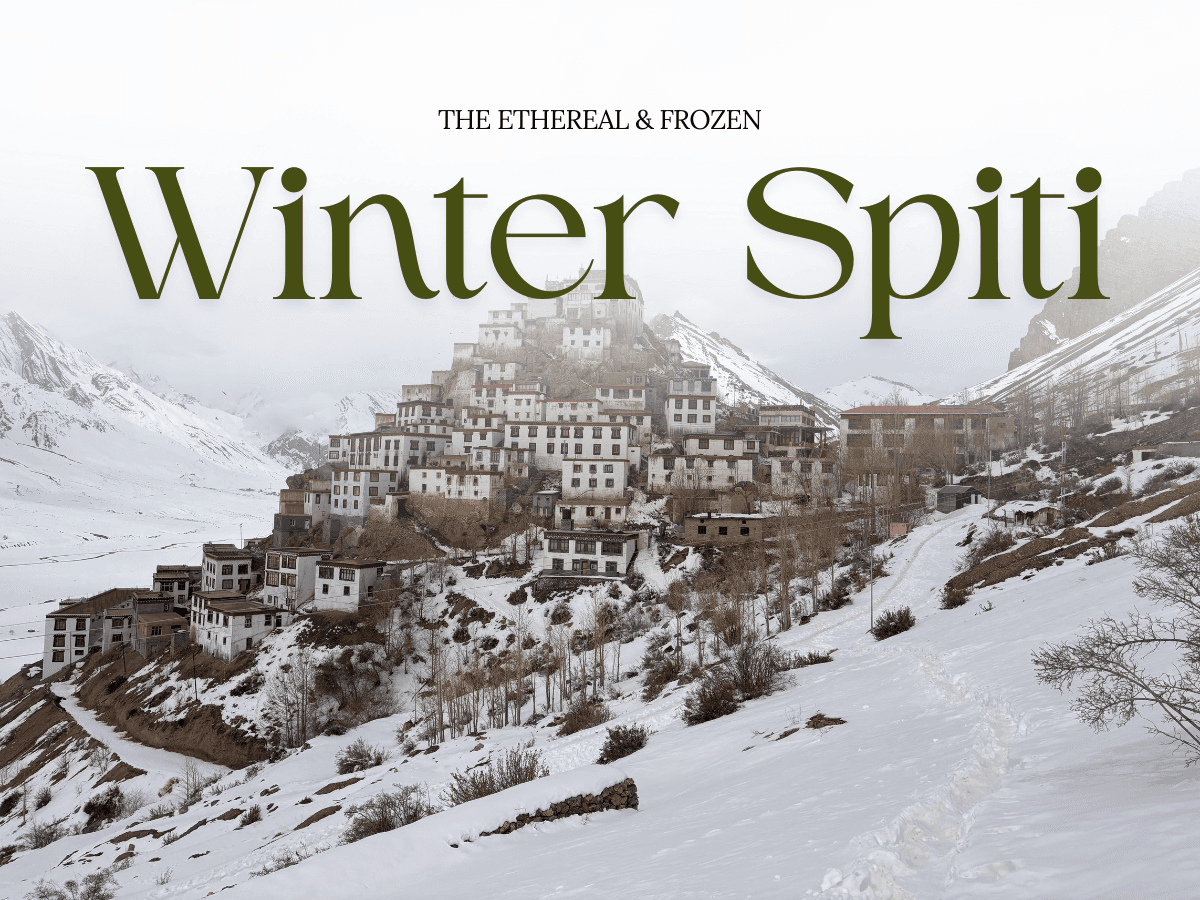
A winter Spiti trip means going in through Shimla and Kinnaur, because the Manali side over Kunzum Pass is snowed shut. Expect night temperatures well below −15°C, simple village homestays with little running water, and a valley that is quiet, white and almost empty of tourists. Our Winter Spiti trip does it in 6 nights and 7 days from Delhi, starting from ₹16,999 per person.
At a glance
| Duration | 6 nights / 7 days (overnight AC bus from Delhi to Shimla and back) |
| Best months for snow | December to February (roads are more reliable in late November and March) |
| Route | Delhi → Shimla → Sangla/Chitkul → Nako → Tabo → Kaza → Kalpa → Shimla → Delhi |
| Highest point on our route | Komic village, about 4,587 m |
| Difficulty | Not a trek, but tough: extreme cold, altitude, long drives, basic stays |
| Cost from | ₹16,999 per person (quad sharing) + 5% GST |
| Starts from | Delhi, every Friday night |
Why Spiti in winter
In summer Spiti is a brown and ochre cold desert full of bikers and SUVs. In winter the same valley goes white, the Spiti river freezes in stretches, and most visitors disappear. What you get instead:
- Snow on the monasteries. Key Monastery (about 4,166 m) and the cliff-top Dhankar Gompa look completely different under snow. Tabo, founded in 996 CE, is one of the oldest Buddhist monasteries still working in the Himalayas, and its meditation caves in the cliff above are part of our route.
- Villages as they really live. With the tourist season over, you see how families in Kaza, Langza and Komic get through the cold months: stored food, bukhari stoves, very little water.
- Wildlife. Winter is the season when snow leopards, ibex and blue sheep come lower down around Kibber. Sightings are never guaranteed and usually distant, and our itinerary is not a dedicated tracking trip, so treat any sighting as luck.
- Night skies. Very dry air, little light pollution and long nights make for serious stargazing, if you can stand outside for it.
The trade-off is real: it is uncomfortable, and plans change with the weather. That is the trip.
The route in winter
Spiti has two road approaches, and only one of them works in winter.
Manali – Atal Tunnel – Kunzum Pass – Kaza (closed). Kunzum Pass sits at about 4,551 m. It is normally open only from around June/July to October/November, and shuts with the first heavy snow. The Border Roads Organisation (BRO) clears it again in spring. In 2026 it reopened in the second half of May.
Shimla – Kinnaur – Kaza (open, most of the time). This is the national highway that climbs slowly along the Sutlej through Narkanda, Rampur, Reckong Peo, Pooh and Nako before turning into Spiti at Sumdo and Tabo. It stays motorable through winter, but fresh snow or landslides can shut sections for hours or days, especially around Nako and the Malling Nallah stretch. It is also a long way: Wikipedia puts Shimla to Kaza at roughly 410–470 km depending on the exact road taken.
The Kinnaur approach has one big plus: you gain height gradually over several days, which is kinder to your body than going straight up from Manali.
Permits. Indian citizens do not need an inner line permit for Kinnaur or Spiti, but carry a government photo ID. Foreign nationals need a permit for the protected stretch around Nako, Tabo and Kaza. Our trip price includes whatever inner line permits the trip needs.
Weather and roads by month
Temperature data for Spiti is patchy and sources disagree a lot, so read these as rough ranges for Kaza (about 3,650 m to 3,800 m depending on the source), not forecasts. Wikipedia records January lows around −30°C.
| Month | Daytime | Night | Roads and conditions |
|---|---|---|---|
| November | Around or just below 0°C | About −10°C to −20°C | Kunzum closed for the season. Kinnaur route usually clear. Little snow yet, landscape still brown with patches of white. |
| December | Often below 0°C | About −15°C to −25°C, colder on clear nights | First proper snowfalls. Short delays on the Kinnaur road after snow. Water pipes start freezing. |
| January | Usually well below 0°C | About −20°C to −30°C | Coldest month. Heaviest snow spells (in 2025–26 the big one came in late January). Highest chance of a day lost to a road block. |
| February | Below 0°C | About −20°C to −25°C | Still deep winter, snow on the ground. Good for the snow-leopard season around Kibber. |
| March | Around 0°C, warming | About −10°C to −20°C | Days get longer and a little milder. Snow on the ground in higher villages. Kunzum still closed. |
Ranges drawn from Wikipedia and published climate averages as of September 2026. Always check the forecast and road status in the week you travel.
The practical message: December to February gives you the "winter Spiti" you have seen in photos, and also the most risk of delays. Late November and March are easier on the body but less snowy.
Our 7-day route, day by day
This is the route on our Winter Spiti backpacking trip. The team captain may reorder or shorten days if roads or weather demand it.
Day 0 – Friday night: leave Delhi. The AC bus leaves Delhi between 9:00 and 11:30 pm.
Day 1 – Shimla to Sangla. Reach Shimla between 8 and 9 am and switch to a tempo traveller. Photo stop at the Kinnaur gate, reach Sangla by evening, check in and get a briefing for the next day.
Day 2 – Chitkul, Khab, Nako, Tabo. After breakfast, explore Chitkul (about 3,450 m), the last village on the road up the Baspa valley. Then a long drive past the Khab sangam (where the Spiti river meets the Sutlej) and a stop in Nako (about 3,600 m) before reaching Tabo for the night.
Day 3 – Tabo, Dhankar, Kaza. Visit Tabo Monastery and its caves, with a short meditation session. Then Dhankar Monastery (about 3,894 m), once the seat of Spiti's rulers, perched on a ridge. Reach Kaza for dinner and the night.
Day 4 – Key Monastery and Chicham Bridge. Morning at Key Monastery, then Chicham Bridge, the suspension bridge built by BRO at about 4,145 m (13,596 ft) over a deep gorge between Kibber and Chicham, often called the highest in Asia. Back in Kaza, free time in the market.
Day 5 – Hikkim, Komic, Langza. Send postcards from Hikkim's post office (about 4,440 m, widely billed as the world's highest). Then Komic (about 4,587 m), one of the highest villages you can drive to, and Langza, known for marine fossils from when this land lay under the ancient Tethys Sea. Night in Kaza.
Day 6 – Kaza to Kalpa. Pack up and drive back down towards Kinnaur, stopping at Gue Monastery. Night in Kalpa (about 2,960 m), facing the Kinnaur Kailash range.
Day 7 – Kalpa to Shimla and Delhi. Early breakfast, a stop at Suicide Point near Kalpa, then the long drive to Shimla and an overnight Volvo to Delhi.
In practice you leave Delhi on a Friday night and board the bus home from Shimla the following Friday. Your exact reporting point and times are shared after booking.
What to pack
Pack for nights near −25°C outside and rooms that may not stay heated all night. Layers beat one heavy jacket.
Clothing
- 2 sets of thermal innerwear (top and bottom), one kept dry just for sleeping
- 2 fleece or woollen mid-layers
- A proper down jacket rated for sub-zero temperatures (a city puffer is not enough)
- Windproof, waterproof outer shell or ski-style jacket
- Insulated or fleece-lined trousers, plus a waterproof overpant if you have one
- Woollen socks (4–5 pairs) and a couple of liner socks
- Snow boots or waterproof trekking boots with good grip, half a size roomy for thick socks
- Woollen cap, balaclava or neck gaiter, and two pairs of gloves (a thin liner and a thick waterproof pair)
Gear
- UV-protection sunglasses; snow glare is harsh
- Headlamp with spare batteries
- Power banks (the cold drains batteries fast, so keep phones and batteries inside your jacket)
- An insulated bottle, because pipes freeze and cold water is miserable
- Hand warmers and a hot-water bag if you feel the cold badly
Toiletries and health
- Wet wipes, dry shampoo and hand sanitiser (washing with running water will be rare)
- Heavy moisturiser, SPF 50 sunscreen and lip balm with SPF
- Your personal medicines, plus anything your doctor advises for altitude
- A small basic first-aid pouch (we carry first aid, but your own plasters and painkillers are handy)
Also carry: a government photo ID, cash (don't count on card machines or ATMs working), and snacks such as dry fruit and chocolate for long drives.
Altitude, cold and safety
Most of this trip is spent between about 3,000 m and 4,600 m. Acute mountain sickness (AMS) can hit anyone above roughly 2,500–3,000 m, whatever their fitness.
- Go slow on arrival. The Kinnaur route helps because you sleep at Sangla, then Tabo, before Kaza. Don't rush around on the first evening at a new height.
- Know the warning signs: headache that doesn't ease, nausea, dizziness, breathlessness at rest, confusion or unusual tiredness. Tell the team captain early; the fix for serious symptoms is to go lower.
- Hydrate even though you don't feel thirsty. Cold, dry air dehydrates you quickly. Skip alcohol for the first days.
- Talk to a doctor before you go about altitude medicines such as acetazolamide (Diamox). Don't self-prescribe.
- Oxygen. We keep an oxygen cylinder in the tempo traveller at all times, but that is for emergencies, not a substitute for acclimatising.
- Frostbite and hypothermia. Keep fingers, toes and ears covered outdoors, change out of wet socks at once, and don't sit still in the open for long after dark.
- Buffer days. A road block after snow can keep a group in one village for an extra day. Don't book an important meeting or flight for the morning after you're due back in Delhi.
- Insurance. Travel insurance isn't included in our price. Get a policy that covers high-altitude travel and evacuation.
Cost
Our Winter Spiti trip is priced per person, with 5% GST added on top.
| Sharing | Price | With 5% GST (approx.) |
|---|---|---|
| Quad sharing | ₹16,999 | ₹17,849 |
| Triple sharing | ₹17,999 | ₹18,899 |
| Dual sharing | ₹18,999 | ₹19,949 |
Included: AC bus from Delhi to Shimla and back, all sightseeing by tempo traveller, 6 nights of stay (mostly village homestays, as most hotels close in winter), 12 meals, all inner line permits, a team captain throughout, an oxygen cylinder in the vehicle 24/7, and driver night charges, tolls, parking and fuel.
Not included: 5% GST, extra food, drinks, tea and snacks, entry tickets or activities outside the plan, travel insurance, medical costs beyond first aid, tips, laundry, mineral water and personal items, and any extra cost from landslides, road closures or other events outside our control.
Budget a little extra for the meals not covered in the 12, hot drinks along the way (you will want a lot), postcards at Hikkim, and a cushion in case a road block adds a night.
Who shouldn't go
Winter Spiti is not for everyone, and it's better to know that before paying:
- Anyone with heart or lung conditions, uncontrolled blood pressure, or who is pregnant, unless a doctor has clearly cleared high-altitude travel in extreme cold.
- People who need a hot shower every day. Expect limited water, often no running water in bathrooms, and basic local food.
- Travellers on a fixed return date with no slack. Snow can add a day.
- Anyone who hates long drives. Several days involve many hours in a vehicle.
- First-timers to the mountains who would rather have comfort. Try a summer Himalayan trip or one of our weekend trips from Delhi first.
If you're torn between this and a Ladakh trip, our Spiti vs Ladakh comparison lays out the differences side by side.
Ready to see the valley under snow? Check the upcoming Friday departures on the Winter Spiti trip page, or contact us with questions about fitness, packing or dates.
FAQs
Is Spiti open in winter?
Yes, through Shimla and Kinnaur. The Manali–Kaza road over Kunzum Pass is closed from around October/November until BRO clears it in late spring. The Kinnaur road stays open most of the time but can be blocked for a while after heavy snow.
What is the temperature in Spiti in December and January?
Nights in Kaza commonly drop to somewhere between −15°C and −30°C, with January the coldest month. Daytime temperatures often stay below freezing. Sources vary a lot, so check a forecast in the week you travel.
Do Indians need a permit for Spiti in winter?
No. Indian citizens don't need an inner line permit for Kinnaur or Spiti, but carry a photo ID. Foreign nationals do need one for the protected stretch.
Will I see a snow leopard?
Maybe, but don't count on it. Winter is the season when they come lower around Kibber, but sightings are usually distant and depend on luck, and our route isn't a dedicated tracking trip.
Where do we stay in winter?
Mostly village homestays, because most hotels shut for the cold. Expect warm blankets and simple home food, but limited water and often no running water in bathrooms.
Can I join solo?
Yes. Many travellers join solo, and we run departures every Friday.
Sources
- Wikipedia, Kaza, Himachal Pradesh: https://en.wikipedia.org/wiki/Kaza,_Himachal_Pradesh
- Wikipedia, Spiti Valley: https://en.wikipedia.org/wiki/Spiti_Valley
- Wikipedia, Kunzum Pass: https://en.wikipedia.org/wiki/Kunzum_Pass
- Wikipedia, Key Monastery: https://en.wikipedia.org/wiki/Key_Monastery
- Wikipedia, Tabo Monastery: https://en.wikipedia.org/wiki/Tabo_Monastery
- Wikipedia, Dhankar Gompa: https://en.wikipedia.org/wiki/Dhankar_Gompa
- Wikipedia, Chitkul: https://en.wikipedia.org/wiki/Chitkul
- Wikipedia, Nako, Himachal Pradesh: https://en.wikipedia.org/wiki/Nako,_Himachal_Pradesh
- Wikipedia, Kalpa, Himachal Pradesh: https://en.wikipedia.org/wiki/Kalpa,_Himachal_Pradesh
- District Kinnaur, Tourist Guidelines (permits for foreigners): https://hpkinnaur.nic.in/tourism-guide/
- Snow Leopard Trust, on winter visitors to Kibber: https://snowleopard.org/when-the-world-comes-for-the-snow-leopard/
- Weather and Climate, Spiti Valley monthly averages: https://weather-and-climate.com/India/spiti-valley/weather-by-month
- Kinnaur–Spiti road status 2026: https://discoverwithdheeraj.com/delhi-kinnaur-spiti-valley-road-status-conditions/
- Winter Spiti road conditions: https://travelcoffee.in/blog/winter-spiti-valley-guide
Last checked: September 2026.